Machine Learning

[CFP] 4th Workshop on AI Music Generation and Competition

Abbreviated Title: 
AIMG 2026
ACL-Sponsored Event: 
No
Event Notification Type: 
Call for Papers
Submission Deadline: 
Monday, 26 October 2026
Contact: 
Ellie Zhang
Contact Email: 
elzhang [at] intellisky.org
Description/Details: 

4th International Workshop on AI Music Generation & Competition (Online)
https://cross-ai.io/conference/2027/preconf/workshops/aimg-2026/

(Held in conjunction with IEEE Big Data 2026 and the Cross-AI Symposium 2026)

Introduction
------------
Music can touch the hearts of any audience without them possessing any knowledge of its context. The power of music is transcendental, and it stems from the timbre of the instrument(s), the fundamental rhythmic structure and melody, the dynamics, instrumentation, and many more, all of which cooperate in some form of harmony to create the final product. However, music is from not only the harmonious sounds produced from instruments, but also nature itself. The elegant songs sung by songbirds, the ringing water droplets, the enchanting waterfalls, the rustling leaves blown by the wind, the crashing waves at a beach, and many more are only a few examples of nature’s music.

With the recent rise of Artificial Intelligence-Generated Contents (AIGC), AI for music is a promising field full of creativity, novel methodologies, and technologies that are yet to be explored. Currently, AI for music methods have been commonly concentrated on utilizing machine learning and deep learning techniques to generate new music. Despite the significant milestones that have been achieved thus far, many are not necessarily robust for a wide range of applications.

AI music itself is a timely topic. This workshop aims to generate momentum around this topic of growing interest, and to encourage interdisciplinary interaction and collaboration between AI, music, Natural Language Processing (NLP), machine learning, multimedia, Human-Computer Interaction (HCI), audio processing, computational linguistics, and neuroscience. It serves as a forum to bring together active researchers and practitioners from academia and industry to share their recent advances in this promising area.

An AI-based music composition competition is incorporated into this workshop to stimulate both scientific and artistic creativity as well as provide such a unique platform. All researchers, musicians, lyricists, and hobbyists are welcome to submit their research works, compositions, and musical genres of all kinds are welcomed as well. The compositions may be comprised of original or human-enhanced AI-generated scores/lyrics.

Topics
------
This is an open call for papers, which includes original contributions considering recent findings in theory, applications, and methodologies in the field of AI music generation. The list of topics includes, but not limited to:
• Machine learning/AI for music
• Natural language processing for music generation
• Algorithmic music generation
• Music generation based on a specific aspect: Lyrical, chordal, motivic, melodic, and rhythmic
• AI-generated lyrics
• AI-generated instrumental audio (including vocal)
• Computational musicology
• AI music interpretation
• AI music data representation
• Music evaluation metrics
• Multiple-Channel AI music generation
• AI musical fusion (notes, audio, etc.)
• AI generation for musical performance and expression
• AI music enhancement (e.g. AI-generated instrumentation)
• AI musical ethics
• AI music generation datasets
• Human-Centered Interaction (HCI) for AI music generation
• AI music for neuroscientific applications
• AI-aided music theory applications
• Bird song generation and translation
• Nature song generation

Important Dates
---------------
Please visit the workshop website for more details:
https://cross-ai.io/conference/2027/preconf/workshops/aimg-2026/

Submission deadlines:
Oct 19, 2026: Submission of full (8-10 pages) and short (5-7 pages) papers
Oct 26, 2026: Submission of poster abstracts (3-4 pages) and demo papers (2-3 pages)
Oct. 26, 2026: Submission of AI musical compositions (1- or 2-page abstract, 1 sheet music, and 1 mp3 audio)

Submission
----------
All submissions are made through the AirBalloon conference management system and evaluated through a unified process. Authors may choose to publish in the IEEE Big Data conference proceedings or the indexed Cross-AI conference proceedings, with the corresponding registration fees. Please refer to the respective official registration pages (Cross-AI registration and the IEEE Big Data 2026 website) for current fees and registration details. At least one author must register for the corresponding event to present their work.

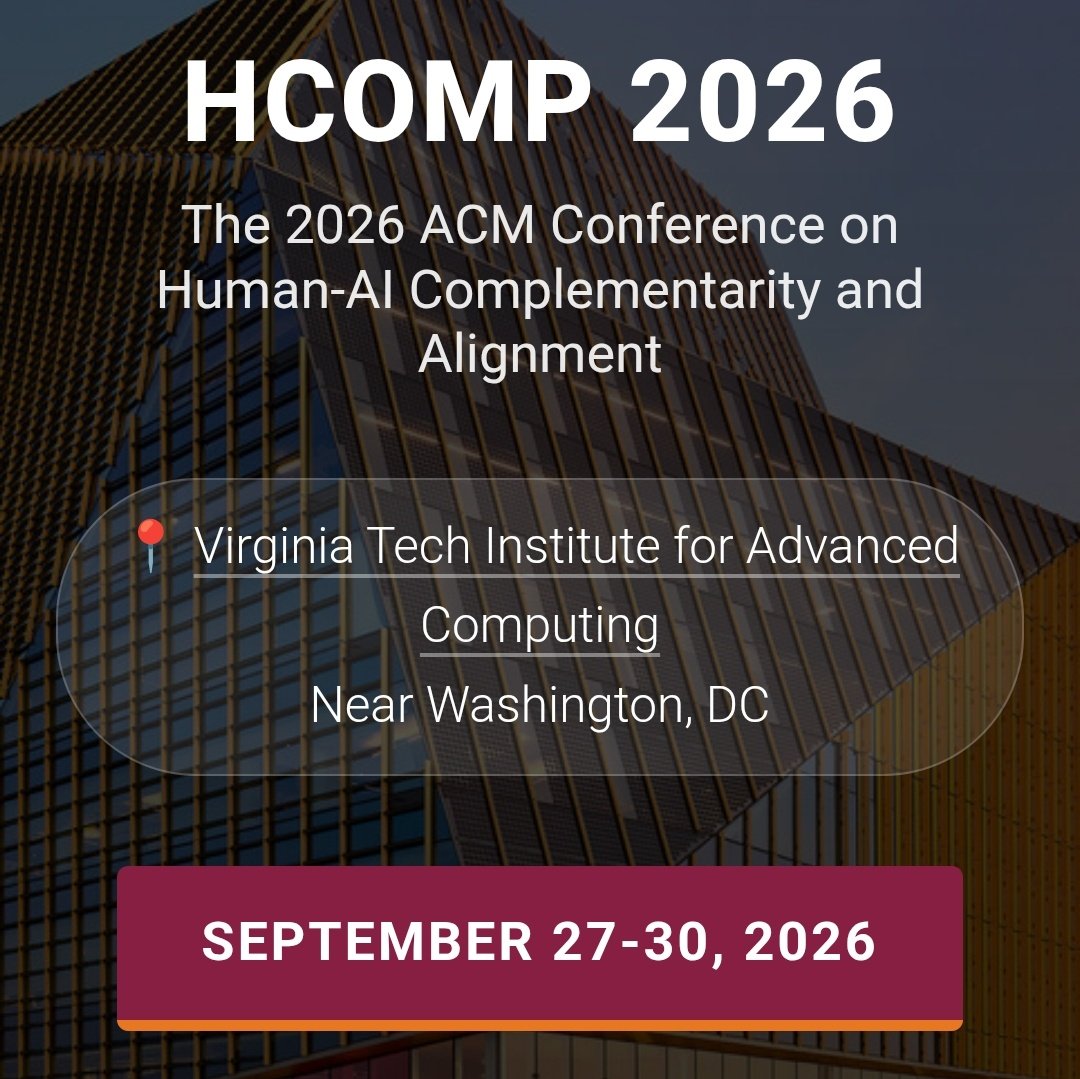
1st CFP: ACM HCOMP 2026 - The 2026 ACM Conference on Human-AI Complementarity and Alignment

Abbreviated Title: 
1st CFP: ACM HCOMP 2026
ACL-Sponsored Event: 
No
Event Notification Type: 
Call for Participation
Location: 
Near Washington DC Area
File attachments: 
AttachmentSize
Image icon HGen1WEawAAaD5d.jpg189.44 KB
Event Dates: 
Sunday, 27 September 2026 to Wednesday, 30 September 2026
Submission Deadline: 
Monday, 1 June 2026
Contact: 
Ting-Hao 'Kenneth' Huang
Kurt Luther
Contact Email: 
txh710 [at] psu.edu
kluther [at] vt.edu
Country: 
USA
Description/Details: 

Call for Participation: ACM HCOMP 2026

The 2026 ACM Conference on Human-AI Complementarity and Alignment
September 27–30, 2026 | Washington, D.C. Area

ACM HCOMP 2026 is the premier venue for research on how human and artificial intelligence can work together as complementary partners. This year’s conference marks a significant evolution: building on a decade of leadership in human computation and crowdsourcing as an AAAI series, HCOMP has transitioned to the ACM and established human-AI complementarity and alignment as its permanent core theme. This broader perspective addresses the full lifecycle of AI systems--from how they are built and evaluated to how they are governed and used in real-world practice.

HCOMP 2026 is co-located with ACM Collective Intelligence (CI) 2026 at the Virginia Tech Institute for Advanced Computing, fostering an interdisciplinary community across NLP, HCI, AI, social computing, economics, and ethics.

Example Research Topics for HCOMP

  • Human-AI Complementarity: Collaboration, coordination, and hybrid workflows.
  • Human-Centered Alignment: Scalable oversight, trust, and repairing misalignment.
  • Human Contributions to AI: Crowdsourcing, RLHF, and responsible data practices.

Submission Tracks

  • Full Papers: Archival research (max 6,000 words) published in the ACM Digital Library.
  • Talks: Non-archival presentations (max 1,500 words) for sharing work-in-progress or results intended for future journal publication.

Important Dates (AoE)

  • June 1, 2026: Abstracts Due
  • June 8, 2026: Papers Due
  • July 31, 2026: Notifications
  • August 13, 2026: Camera ready due
  • September 27–30, 2026: Conference Dates

Full details available at: https://www.humancomputation.com/2026/submit.html

Call for Participation: Shared Task on Medical Decision Extraction (MedExACT) @ BioNLP ACL 2026

Abbreviated Title: 
MedExACT @ BioNLP ACL 2026
ACL-Sponsored Event: 
This is an ACL Sponsored Event
Event Notification Type: 
Call for Participation
Location: 
BioNLP @ ACL 2026
Event Dates: 
Tuesday, 7 July 2026
Submission Deadline: 
Sunday, 5 April 2026
Contact: 
Mohamed Elgaar
Hadi Amiri
Contact Email: 
mohamed_elgaar [at] uml.edu
hadi_amiri [at] uml.edu
City: 
San Diego
State: 
CA
Country: 
USA
Description/Details: 

We are excited to announce the first Medical Decision Extraction, Analysis, and Classification Task (MedExACT) shared task, co-located with the BioNLP workshop at ACL 2026.

=== Overview ===

MedExACT focuses on detecting and labeling medical decisions in ICU discharge summaries. Given a full discharge summary, systems must detect contiguous text spans that express medical decisions and assign each span one of ten categories defined by the the Decision Identification and Classification Taxonomy for Use in Medicine (DICTUM) (Ofstad et al., 2016) (e.g., Defining Problem, Therapeutic Procedure, Drug, Evaluation).

=== Data ===

Participants will use the MedDec dataset (https://aclanthology.org/2024.findings-acl.975.pdf) (Elgaar et al., 2024), which contains over 56k expert-annotated decision spans drawn from de-identified ICU discharge summaries in MIMIC-III. The data is supplemented with patient demographics to facilitate robustness analysis.

=== Evaluation & Prize ===

  • Robustness: Systems will be evaluated for accuracy and robustness across patient subgroups (Sex, Race, and Language Proficiency) at both span and token levels. The final ranking metric is the average of the Base Score and the Worst-Group F1 across patient subgroups.
  • Prize: We will cover the full ACL 2026 registration fee for the top three teams (one member per team).

=== Important Dates ===

  • Train/Validation data release: January 1, 2026
  • Test set release: March 23, 2026
  • Prediction submission deadline: April 5, 2026
  • Results notification: April 24, 2026
  • System papers due: May 5, 2026
  • Workshop day (tentative): July 7, 2026

=== Organizers ===

  • Mohamed Elgaar (UMass Lowell)
  • Jiali Cheng (UMass Lowell)
  • Nidhi Vakil (UMass Lowell)
  • Mitra Mohtarami (Anselm College)
  • Adrian Wong (BIDMC)
  • Hadi Amiri (UMass Lowell)
  • Leo A. Celi (MIT, BIDMC)

We warmly invite the community to participate in this task to advance clinical decision extraction.

Best regards,

MedExACT Organizers

NLDB 2025 : The 30th International Conference on Natural Language & Information

Abbreviated Title: 
NLDB 2025
ACL-Sponsored Event: 
No
Event Notification Type: 
Call for Papers
Location: 
Kanazawa Chamber of Commerce and Industry
Event Dates: 
Friday, 4 July 2025 to Sunday, 6 July 2025
Submission Deadline: 
Sunday, 16 March 2025
Contact Email: 
nldb2025 [at] easychair.org
City: 
Kanazawa
State: 
Ishikawa
Country: 
Japan
Description/Details: 

The 30th International Conference on Natural Language & Information Systems (NLDB 2025)
==========

Conference Website
----------
https://www.jaist.ac.jp/event/nldb2025

Dates and Venue
----------
4-6 July 2025
Kanazawa Chamber of Commerce and Industry
9-13 Oyamamachi, Kanazawa, Ishikawa 920-0918, Japan

Introduction
----------
The 30th International Conference on Natural Language & Information Systems (NLDB 2025) will be held in the City of Kanazawa, Japan from July 4-6, 2025. More details on the conference program, registration, and accommodation will be announced in due time.

Since 1995, the NLDB conference has brought together researchers, industry practitioners, and potential users interested in applying Natural Language Processing (NLP) to Database and Information Systems. Topics cover a wide range of NLP applications in Information and Communication Systems, including Big Data, Linked Data and Social Networks.

In recent years, NLP has seen exciting advances like Large Language Models, transparency and bias in AI, multimodal models combining NLP and Computer Vision, and conversational AI. These innovations are now powering real-world enterprise applications like recommender systems, sentiment analysis, chatbots, and more.
Thanks to open-source communities, pre-trained language models can now be easily fine-tuned on custom datasets. Businesses are rapidly adopting these latest NLP technologies to solve industry problems.

The 30th NLDB conference provides a forum to share the latest research and industrial applications of NLP across information systems. We welcome novel, unpublished works on all NLP topics and their applications.

Call for Papers
----------
NLDB 2024 invites authors to submit papers for oral presentations on unpublished research that addresses theoretical aspects, algorithms, applications, architectures for applied and integrated NLP, resources for applied NLP, and other aspects of NLP, as well as survey and discussion papers. This year’s edition of NLDB continues with the Industry Track, to foster fruitful interaction between the industry and the research community.

Topics of interest include but are not limited to:
- Large Language Models: training, applications, transfer learning, interpretability of large language models.
- Multimodal Models: Integration of text with other modalities like images, video, and audio; multimodal representation learning; applications of multimodal models.
- AI Safety and ethics: Safe and ethical use of Generative AI and NLP; avoiding and mitigating biases in NLP models and systems; explainability and transparency in AI.
- Natural Language Interfaces and Interaction: design and implementation of Natural Language Interfaces, user studies with human participants on Conversational User Interfaces, chatbots and LLM-based chatbots and their interaction with users.
- Social Media and Web Analytics: Opinion mining/sentiment analysis, irony/sarcasm detection; detection of fake reviews and deceptive language; detection of harmful information: fake news and hate speech; sexism and misogyny; detection of mental health disorders; identification of stereotypes and social biases; robust NLP methods for sparse, ill-formed texts; recommendation systems.
- Deep Learning and eXplainable Artificial Intelligence (XAI): Deep learning architectures, word embeddings, transparency, interpretability, fairness, debiasing, ethics.
- Argumentation Mining and Applications: Automatic detection of argumentation components and relationships; creation of resource (e.g. annotated corpora, treebanks and parsers); Integration of NLP techniques with formal, abstract argumentation structures; Argumentation Mining from legal texts and scientific articles.
- Question Answering (QA): Natural language interfaces to databases, QA using web data, multi-lingual QA, non-factoid QA(how/why/opinion questions, lists), geographical QA, QA corpora and training sets, QA over linked data (QALD).
- Corpus Analysis: multi-lingual, multi-cultural and multi-modal corpora; machine translation, text analysis, text classification and clustering; language identification; plagiarism detection; information extraction: named entity, extraction of events, terms and semantic relationships.
- Semantic Web, Open Linked Data, and Ontologies: Ontology learning and alignment, ontology population, ontology evaluation, querying ontologies and linked data, semantic tagging and classification, ontology-driven NLP, ontology-driven systems integration.
- Natural Language in Conceptual Modelling: Analysis of natural language descriptions, NLP in requirement engineering, terminological ontologies, consistency checking, metadata creation and harvesting.
- Natural Language and Ubiquitous Computing: Pervasive computing, embedded, robotic and mobile applications; conversational agents; NLP techniques for Internet of Things (IoT); NLP techniques for ambient intelligence
- Big Data and Business Intelligence: Identity detection, semantic data cleaning, summarisation, reporting, and data to text.

Important Dates*
----------
1 Oct 2024: Call for papers
28 Feb 2025: Submission deadline
16 Mar 2025: Submission deadline (Extended)
18 Apr 2025: Authors notification
9 May 2025: Camera ready
4-6 July 2025: Conference

*All deadlines are 11:59PM UTC-12:00 AoE

Submission Guidelines:
----------
Authors should follow the LNCS format (https://www.springer.com/gp/computer-science/lncs/conference-proceedings...) and submit their manuscripts in PDF via Easychair (https://easychair.org/conferences/?conf=nldb2025)

Papers can be submitted to either the main conference or the industry track.

Submissions can be full papers (up to 15 pages including references and appendices), short papers (up to 11 pages including references and appendices) or papers for a poster presentation or system demonstration (6 pages including references). The program committee may decide to accept some full papers as short papers or poster papers.

The conference proceedings will be publisehd in Lecture Notes in Computer Science (LNCS, Springer). Best papers will be invited to publish in the special issue of Data & Knowledge Engineering (DKE, Elsevier).

Contact
----------
All questions about submissions should be emailed to: nldb2025 [at] easychair.org

CoNLL 2025: 2nd Call for Papers

Abbreviated Title: 
ACL-Sponsored Event: 
This is an ACL Sponsored Event
Event Notification Type: 
Call for Papers
Location: 
Event Dates: 
Thursday, 31 July 2025 to Friday, 1 August 2025
Submission Deadline: 
Friday, 14 March 2025
Contact: 
Contact Email: 
conll.chairs [at] gmail.com
City: 
Vienna
State: 
Country: 
Austria
Description/Details: 

CoNLL 2025: 2nd Call for Papers
Vienna, Austria, July 31 - August 1, 2025 (co-located with ACL)
https://www.conll.org/

NEW! This year, CoNLL will only accept direct submissions…
NEW! … both archival and non-archival! (see below)

SIGNLL invites submissions to the 29th Conference on Computational Natural Language Learning (CoNLL 2025). The focus of CoNLL is on theoretically, cognitively and scientifically motivated approaches to computational linguistics. We welcome work targeting any aspect of language and its computational modeling, including but not only:

- Computational Psycholinguistics, Cognition and Linguistics
- Computational Social Science and Sociolinguistics
- Interaction and Dialogue
- Language Acquisition, Learning, Emergence, and Evolution
- Multimodality and Grounding
- Typology and Multilinguality
- Speech and Phonology
- Syntax and Morphology
- Lexical, Compositional and Discourse Semantics
- Theoretical Analysis and Interpretation of ML Models for NLP
- Resources and Tools for Scientifically Motivated Research

Submissions

Submission will be via OpenReview. We accept two types of submission: archival, and non-archival.

Non-archival submissions are not anonymous. We will accept submissions that fit into CoNLL’s scope (see above for a description) and have been published in 2023, 2024, and 2025 in relevant conferences (*ACL, COLING, NeurIPS, ICLR, …) and journals (TACL, Computational Linguistics, other journals in the areas of interest for CoNLL). We are working on the submission site, we’ll announce it on the CoNLL website and social media, as well as in the 3rd CfP. Submissions that are accepted will be presented at the conference either as talks or as poster presentations.

Archival submissions must be anonymous and use the same template as the ACL 2025. Submitted papers may consist of up to 8 pages of content plus unlimited space for references. Authors of accepted papers will have an additional page to address reviewers’ comments in the camera-ready version (9 pages of content in total, excluding references). Optional anonymized supplementary materials and a PDF appendix are allowed. The appendix should be submitted as a separate PDF file (reviewers are not required to consider the materials in the appendix so it should not include any essential content to the understanding of the paper). Please refer to the ACL website for more details on the submission format. Note that, unlike ACL, we do not mandate that papers have a discussion section of the limitations of the work. However, we strongly encourage authors to have such a section in the appendix.

The submission page for archival papers can be found here: https://openreview.net/group?id=aclweb.org/ACL/2025/Workshop/CoNLL

Multiple submission policy: CoNLL 2025 follows the ACL 2025 policy, which follows the ARR policy: https://aclrollingreview.org/cfp#multiple-submission-policy: CoNLL “precludes multiple submissions […] will not consider any paper that is under review in a journal or another conference at the time of submission, and submitted papers must not be submitted elsewhere during the […] review period. This policy covers all journals and refereed and archival conferences and workshops […] In addition, we will not consider any paper that overlaps significantly in content or results with papers that will be (or have been) published elsewhere.” Authors submitting more than one paper to CoNLL 2025 must ensure that the submissions do not overlap significantly (>25%) with each other in content or results.

As for submission of pre-prints to arXiv and other platforms, we follow the same policy as ARR: “[archival] submissions will remain anonymous during peer review, but authors are free to post and discuss non-anonymous preprints at any time.”

Also please be aware of OpenReview's moderation policy for newly created profiles —we advise you to create a profile well in advance:
- New profiles created without an institutional email will go through a moderation process that can take up to two weeks.
- New profiles created with an institutional email will be activated automatically.

Venue / visa

CoNLL 2025 will be held in Vienna, Austria. Please note that it is an in-person conference. We expect all accepted papers to be presented physically and presenting authors must register through ACL (workshop). If you need a visa, we encourage you to submit your visa application at submission time.

Timeline

(All deadlines are 11:59pm UTC-12h, AoE)
(CoNLL only accepts direct submissions this year!)
- Submission deadline (archival and non-archival): March 14 2025
- Notification of acceptance: May 23 2025
- Camera-ready papers due: June 17 2025
- Conference: July 31 - August 1, 2025

Contact

Questions? E-mail conll.chairs@gmail.com

Organization committee

Program Chairs

Gemma Boleda, Universitat Pompeu Fabra / ICREA
Michael Roth, University of Technology Nuremberg

Area Chairs

Christian Bentz, University of Passau
Zhenguang G. Cai, Chinese University of Hong Kong
Tanise Ceron, Bocconi University
Jackie Chi Kit Cheung, McGill University
Iria De Dios, Universitat Pompeu Fabra
Max van Duijn, Leiden University
Kilian Evang, HHU Düsseldorf
Aina Garí Soler, INRIA
Ximena Gutierrez-Vasques, Universidad Nacional Autónoma de México
Dieuwke Hupkes, Meta AI Research
Xixian Liao, Barcelona Supercomputing Center
Brielen Madureira, University of Potsdam
Yohei Oseki, University of Tokyo
Sandro Pezzelle, University of Amsterdam
Emily Prud’hommeaux, Boston College
Tanja Samardžić, University of Zurich
Carina Silberer, University of Stuttgart
Ece Takmaz, Utrecht University
Tessa Verhoef, Leiden University
Yang Xu, University of Toronto
Wei Zhao, University of Aberdeen

Publicity Chairs

Snigdha Chaturvedi, UNC-Chapel Hill
Anvesh Rao Vijjini, UNC-Chapel Hill

Publication Chairs

Emily Cheng, Universitat Pompeu Fabra
Selina Meyer, Technische Universität Nürnberg

Call for Participation: Multimodal Algorithmic Reasoning Workshop at NeurIPS 2024

Abbreviated Title: 
CFP: MAR Workshop @ NeurIPS 2024
ACL-Sponsored Event: 
No
Event Notification Type: 
Call for Participation
Location: 
West Building Exhibit Hall A, Vancouver Convention Center
File attachments: 
AttachmentSize
PDF icon MAR-NeurIPS-24-CfP.pdf56.43 KB
Event Dates: 
Sunday, 15 December 2024
Contact: 
MAR Workshop Organizer
Contact Email: 
smart101 [at] googlegroups.com
City: 
Vancouver
State: 
BC
Country: 
Canada
Description/Details: 

Multimodal Algorithmic Reasoning Workshop (MAR-NeurIPS 2024)
December 15th, 2024, Vancouver
https://marworkshop.github.io/neurips24/

CALL FOR PARTICIPATION

In this workshop, we plan to gather researchers working in neural algorithmic learning, multimodal reasoning, and cognitive models of intelligence to showcase their cutting-edge research, discuss the latest challenges, as well as bring to the forefront problems in perception and language modeling that are often overlooked but are pivotal in achieving true artificial general intelligence. An emphasis is on the emerging topic of multimodal algorithmic reasoning, where a reasoning agent is required to automatically deduce new algorithms/procedures for solving real-world tasks, e.g., algorithms that use multimodal foundational models for analysis, synthesis, and planning, new approaches towards solving challenging vision-and-language mathematical (Olympiad type) reasoning problems, deriving winning strategies in multimodal games, procedures for using tools in robotic manipulation, etc. We hope to dive deep into this exciting topic at the intersection of theory, multimodal machine learning architectures, and cognitive science to understand what we have achieved thus far in machine intelligence and what we are lacking in relation to the human way of thinking – through talks from outstanding researchers and faculty that could inspire the audience to search for the missing rungs on the ladder to true intelligence.

KEYNOTE SPEAKERS

Joshua B. Tenenbaum, MIT
Ranjay Krishna, University of Washington
Stefanie Jegelka, TUM and MIT
Sergey Levine, UC Berkeley
David Duvenaud, University of Toronto

IMPORTANT DETAILS

Date and Time: 8:25 AM - 5:10 PM PST on December 15, 2024
Location:
- West Building Exhibit Hall A, Vancouver Convention Center, Vancouver, BC, Canada
- MAR 2024 on the NeurIPS 2024 virtual platform: https://neurips.cc/virtual/2024/workshop/84713

WORKSHOP ORGANIZERS

Anoop Cherian, Mitsubishi Electric Research Laboratories
Kuan-Chuan Peng, Mitsubishi Electric Research Laboratories
Suhas Lohit, Mitsubishi Electric Research Laboratories
Honglu Zhou, Salesforce AI Research
Kevin A. Smith, Massachusetts Institute of Technology
Tim K. Marks, Mitsubishi Electric Research Laboratories
Juan Carlos Niebles, Salesforce AI Research
Petar Veličković, Google DeepMind

CONTACT
Email: smart101 [at] googlegroups.com
Website: https://marworkshop.github.io/neurips24/

The 13th CCF International Conference on Natural Language Processing and Chinese Computing

Abbreviated Title: 
NLPCC 2024
ACL-Sponsored Event: 
No
Event Notification Type: 
Call for Papers
Location: 
Hangzhou, China
File attachments: 
Event Dates: 
Friday, 1 November 2024 to Sunday, 3 November 2024
Contact: 
Derek F. Wong, University of Macau
Zhongyu Wei, Fudan University
Contact Email: 
nlpcc_general [at] 163.com
derekfw [at] um.edu.mo
zywei [at] fudan.edu.cn
City: 
Hangzhou
State: 
Zhejiang Province
Country: 
China
Description/Details: 

The CCF International Conference on Natural Language Processing and Chinese Computing (NLPCC) is the annual meeting of CCF-NLP (Technical Committee of Natural Language Processing, China Computer Federation). NLPCC is a leading international conference specialized in the fields of Natural Language Processing (NLP) and Chinese Computing (CC). NLPCC is in the list of CS conferences recommended by CCF. It serves as a main forum for researchers and practitioners from academia, industry, and government to share their ideas, research results and experiences, and to promote their research and technical innovations in the fields. Previous NLPCC conferences were successfully held in Beijing (2012), Chongqing (2013), Shenzhen (2014), Nanchang (2015), Kunming (2016), Dalian (2017), Hohhot (2018), Dunhuang (2019), Zhengzhou (2020), Qingdao (2021), Guilin (2022), and Foshan (2023).

Today, NLP and CC technologies are among the most active research and development areas due to the rapid advancement of the Internet as well as the worldwide proliferation of mobile devices and social media. The fields are facing many new challenges arising from intelligent applications and big data, such as business intelligence, social analytics, etc.

NLPCC 2024 welcomes original technical papers on new concepts, innovative research, systems, standards, resources & evaluation, applications, and industrial case studies related to NLP & CC. Authors are invited to submit complete and unpublished papers in the following categories. Please note that this year, NLPCC will ONLY accept submissions in English.

- Applications/tools
- Empirical/data-driven approaches
- Resources and evaluation
- Theoretical
- Survey papers

Papers currently under review in other conferences or journals are acceptable; however, commitment to the conference must be made upon acceptance. Preprints are also permitted, but they must adhere to the anonymized submission requirements. Relevant topics of NLPCC 2024 include, but are not limited to, the following:

Computational Social Science and Social Media
- Dialogue and Interactive Systems
- Discourse and Pragmatics
- Ethics and NLP
- Information Extraction and Knowledge Acquisition
- Information Retrieval and Text Mining
- Interpretability and Analysis of Models for NLP
- Large Language Models
- Linguistic Theories, Cognitive Modeling and Psycholinguistics
- Machine Learning for NLP
- Machine Translation and Multilinguality
- NLP Applications
- Phonology, Morphology and Word Segmentation
- Question Answering
- Resources and Evaluation
- Semantics
- Sentiment Analysis
- Speech and Multimodality
- Syntax: Tagging, Chunking and Parsing
- Text Summarization and Generation

Submission Guidelines:

The proceedings of the conference will be published as a volume in the Springer LNAI series, which is EI & ISTP indexed. Authors should format their submissions according to the LNCS instructions. The maximum length for papers is 12 pages, including references and appendices. Thus, submissions must adhere to the standard Springer style sheets ([LaTeX][Microsoft Word]). All papers should be prepared in PDF format.

Submissions must be made electronically via the OpenReview platform at https://openreview.net/group?id=ccf.org/NLPCC/2024/Conference. Note that submissions sent by email will not be considered.

Every research paper submitted to NLPCC 2024 will undergo a "double-blind" reviewing process: the PC members and referees who review the paper will not know the identity of the authors.

Important dates:

- Paper Submission Deadline: June 11, 2024
- Paper Notification: August 4, 2024
- Camera-ready Deadline: August 15, 2024
- Tutorials: November 1, 2024
- Main Conference: November 2-3, 2024
All deadlines are 23:59 PM, Beijing Time.

Contact:

If you have any questions about paper submission, please contact the Program Co-Chairs at derekfw [at] um.edu.mo and zywei [at] fudan.edu.cn. For more information about the conference, please email nlpcc_general [at] 163.com.

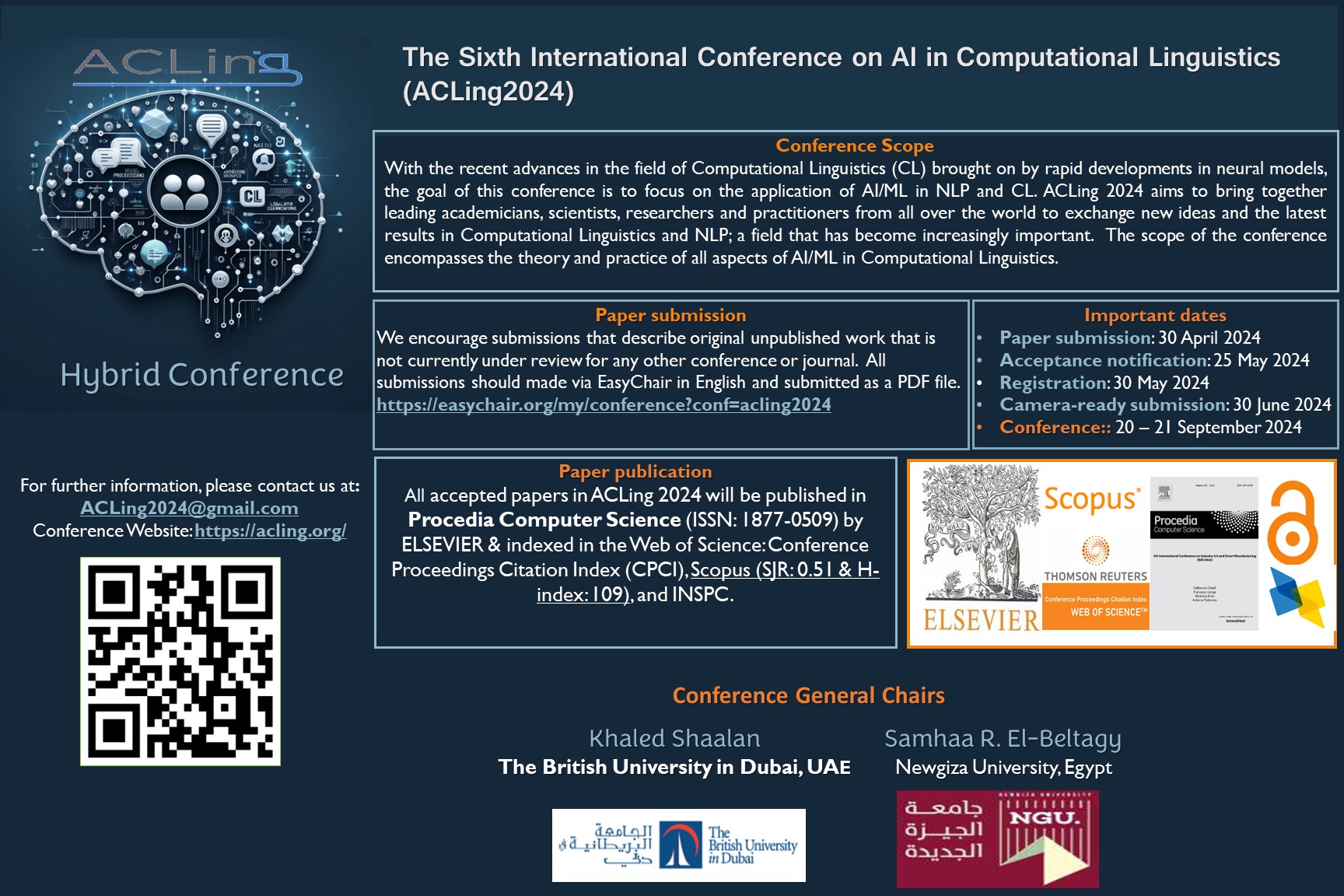
CFP: Sixth International Conference on AI in Computational Linguistics

Abbreviated Title: 
ACLing2024
ACL-Sponsored Event: 
No
Event Notification Type: 
Call for Papers
Location: 
The British University in Dubai
File attachments: 
Event Dates: 
Saturday, 21 September 2024
Submission Deadline: 
Tuesday, 7 May 2024
Contact: 
Khaled Shaalan
Samhaa El-Beltagy
Contact Email: 
khaled.shaalan [at] acm.org
samhaa [at] computer.org
City: 
Dubai
State: 
Dubai
Country: 
United Arab Emirates
Description/Details: 

With the recent advances in the field of Computational Linguistics (CL) brought on by rapid developments in neural models, the goal of this conference is to focus on the application of AI/ML in NLP and CL. The ACLing 2024 aims to bring together leading academicians, scientists, researchers and practitioners from all over the world to exchange new ideas and the latest results in Computational Linguistics and NLP; a field that has become increasingly important. The scope of the conference encompasses the theory and practice of all aspects of AI/ML in Computational Linguistics. The British University in Dubai has been chosen to organize the ACLing2024 conference because it has a mission for establishing itself as a provider of world class scholarship, education and research.

The 1st Workshop on Machine Learning for Ancient Languages @ ACL 2024

Abbreviated Title: 
ML4AL
ACL-Sponsored Event: 
This is an ACL Sponsored Event
Event Notification Type: 
Call for Papers
Location: 
ACL
File attachments: 
AttachmentSize
PDF icon 1st CfP -- ML4AL.pdf73.88 KB
Event Dates: 
Thursday, 15 August 2024
Submission Deadline: 
Friday, 17 May 2024
Contact: 
ML4AL Organizers
Contact Email: 
ml4al.organizers [at] gmail.com
City: 
Bangkok
Country: 
Thailand
Description/Details: 

1st Call for Papers

The 1st Workshop on Machine Learning for Ancient Languages @ ACL 2024
Bangkok, Thailand
Thursday, August 15 2024 (co-located with ACL 2024)
https://www.ml4al.com

DESCRIPTION

Ancient languages preserve the cultures and histories of the past. However, their study is fraught with difficulties, and experts must tackle a range of challenging text-based tasks,
from deciphering lost languages to restoring damaged inscriptions, to determining the authorship of works of literature. Technological aids have long supported the study of ancient texts, but in recent years advances in Artificial Intelligence (AI) and Machine Learning (ML) have enabled analyses on Ancient Languages on an unprecedented scale and in unparalleled detail. The ML4AL Workshop aims to inspire and support research momentum in the emerging field of ML for the study of ancient texts.

The written evidence of the Ancient World is multifaceted and expansive. We invite contributions tackling texts from the diverse corners of the globe, in any language, script or medium. We establish a chronological scope from the inception of writing systems in ancient Mesopotamia and Egypt (3400 BCE) to the late first millennium CE. Encompassing such a vast and fertile remit for ML applications, the ML4AL Workshop is designed to facilitate and invigorate the ongoing collaborative momentum between ML and the Humanities, to foster a deeper understanding of our past. Indeed, ancient languages fall under the category of low-resource languages due to the scarcity of available linguistic data for modern analysis. These languages, therefore, offer a compelling case study for ML: their limited textual material, socio-cultural intricacies, evolving forms, and diverse transmission histories pose a significant challenge to conventional models.

We welcome contributions on topics related to, but not limited to:

  • Digitization: bringing textual sources to a high-quality machine-readable format (e.g., through HTR).
  • Restoration: recovering missing text and reassembling fragmented written artefacts
  • Attribution: contextualising a document within its original geographical, chronological and authorial setting.
  • Linguistic analysis: involving tasks such as POS tagging, text parsing, segmentation, representation learning, semantics, sentiment, language identification.
  • Textual criticism: the process of reconstructing a text's philological tradition of textual transmission, including the tasks of stemmatology and intertextuality.
  • Translation and decipherment: which aim to make a text's language comprehensible and interpretable to modern-day researchers.

We particularly welcome submissions which tackle low-data, underrepresented, non-Western ancient languages, and we encourage researchers and practitioners from diverse backgrounds, working on ancient languages, irrespective of their gender, ethnicity, nationality, or academic affiliations, including fellows tackling low-underrepresented and non-Western centric ancient languages.

SUBMISSION INFORMATION

We welcome long (8 page) and short (4 page) paper submissions, in PDF format, made through OpenReview or ARR. Accepted regular workshop papers will be included in the workshop proceedings, but non-archival submissions are also welcome:

Regular workshop papers: Both long (8 pages) and short (4 pages) papers may have unlimited pages for references and up to 100 MB of supplementary materials (separately). Authors are strongly encouraged to submit their code for reproducibility. In the camera-ready version, one additional page of content will be given to address the comments received by the reviewers. All submissions should be completely anonymous to allow a double-blind review process and the papers should follow the ACL template style. Each paper is expected to be reviewed by at least three reviewers. Selected accepted papers will be presented orally and the rest as posters.

Non-archival submissions: Papers on relevant topics that have appeared or might appear in other venues (workshops, conferences, journals) are also welcome, which can be presented at the workshop but will not be included in the workshop proceedings.

Already published contributions (excluding preprints) cannot be accepted. Papers being submitted both to ML4AL and another venue must note on the title page the other conference/workshop and state on the title page that if the authors choose to present their paper at ML4AL (upon acceptance), then the paper will be withdrawn from other conferences and workshops. All submitted manuscripts should be fully anonymous (please avoid self-references) and must include a dedicated "Limitations" section, which will not count toward the page limit. Supplementary material (e.g., code, data, audio/visual material, etc.) is suggested to be uploaded on a repository, anonymously, and linked to the paper.

ORGANIZING COMMITTEE

Dr John Pavlopoulos, Athens University of Economics and Business, Greece
Dr Thea Sommerschield, University of Nottingham, UK
Dr Yannis Assael, Google DeepMind, UK
Dr Shai Gordin, Ariel University, Israel
Prof. Kyunghyun Cho, NYU, CIFAR, Genentech, USA
Prof. Marco Passarotti, Università Cattolica del Sacro Cuore, Italy
Dr Rachele Sprugnoli, Università di Parma, Italy
Dr Yudong Liu, Western Washington University, USA
Dr Bin Li, Nanjing Normal University, China
Dr Adam Anderson, UC Berkeley, USA
Contact the organizers at: ml4al.organizers [at] gmail.com 

IMPORTANT DATES

  • Paper submission deadline: May 17, 2024
  • Notification of acceptance: June 17, 2024
  • Camera-ready paper due: July 1, 2024
  • Workshop: August 15, 2024


All deadlines are 11:59 pm UTC -12h (“anywhere on Earth”)

PROGRAM COMMITTEE

Masayuki Asahara; John Bodel; Gregory Crane; Katrien De Graef; Sanhong Deng; Mark Depauw; Hanne Eckhoff; Margherita Fantoli; Minxuan Feng; Ethan Fetaya; Federica Gamba; Laura Hawkins; Chul Heo; Petra Heřmánková; Marietta Horster; Renfen Hu; Kyle Johnson; Alek Keersmaekers; Ussen Kimanuka; Thomas Koentges; Els Lefever; Chaya Liebeskind; Eliese-Sophia Lincke; Chao-Lin Liu; Liu Liu; Congjun Long; Jiaming Luo; Massimo Maiocchi; Isabelle Marthot-Santaniello; Barbara McGillivray; M. Willis Monroe; Alex Mullen; Chiara Palladino; Chanjun Park, Upstage; Edoardo M. Ponti; Mladen Popovic; Jonathan Prag; Avital Romach; Edgar Roman-Rangel; Matteo Romanello; Brent Seales; Andrew Senior; Si Shen; Barak Sober; Richard Sproat; Gabriel Stanovsky; Vanessa Stefanak; Silvia Stopponi; Qi Su; Matthew I. Swindall; Xuri Tang; Charlotte Tupman; Dongbo Wang; Haneul Yoo; Chongsheng Zhang

AAAI 2024 Spring Symposium on Clinical Foundation Models

ACL-Sponsored Event: 
No
Event Notification Type: 
Call for Participation
Location: 
Stanford University
Event Dates: 
Monday, 25 March 2024 to Wednesday, 27 March 2024
Submission Deadline: 
Friday, 26 January 2024
Contact: 
Mononito Goswami
Xinyu (Rachel) Li
Contact Email: 
clinicalfms [at] gmail.com
mgoswami [at] andrew.cmu.edu
xinyul2 [at] andrew.cmu.edu
City: 
Stanford
State: 
California
Country: 
USA
Description/Details: 

Symposium Description
Foundation models are rapidly emerging as powerful tools for solving various biomedical tasks, even with limited task-specific data, while specialist machine learning (ML) models can incorporate clinical domain expertise. Both approaches hold promise for improving patient outcomes and streamlining healthcare administration, but several questions remain: (1) What distinguishes them? (2) What challenges exist in their training and application? (3) How can they seamlessly fit into healthcare routines? (4) What's the best way to regulate these technologies?

Important Dates

  • Submission deadline: Jan 5, 2024
  • Notification of acceptance: Feb 9, 2024
  • Final versions of papers due: Mar 8, 2024
  • Symposium: Mar 25, 2024 – Mar 27, 2024

All deadlines are 11:59pm UTC-12:00 (anywhere on Earth)

Relevant topics
Relevant topics for the symposium include, but are not limited to: (1) Clinical foundation model data, pre-training, evaluation, and applications. (2) Innovative ML methods combining healthcare knowledge from physics, biology, and chemistry. (3) Challenges limiting the adoption of ML in healthcare, focusing on usability, trust, robustness, and fairness. (4) New clinical datasets and benchmarks. (5) Regulatory frameworks, ethical considerations, and policy implications of ML for healthcare. (6) Software using foundation models for healthcare challenges, with insights on development and ethics.

Submission Requirements
We invite submissions for two non-archival tracks: Traditional and Non-traditional.

 Traditional Track: We seek papers which explore novel approaches or offer fresh insights into the core questions targeted by this symposium. Full papers can be up to 4 pages long with unlimited pages for references and appendices. All submissions undergo a double-blind review, must be anonymized, and should not have been published or under review elsewhere. Nevertheless, authors can later publish their work in other venues due to the symposium's non-archival nature.

Non-traditional Track: We invite all sorts of non-traditional research contributions. This includes papers describing software tools, datasets, benchmarks, clinical abstracts, or previously published research findings that can stimulate insightful discussions among the symposium attendees. These submissions should be up to 2 pages long with unlimited pages for references and appendices. The review process is single-blind. Submissions can be previously published or under review elsewhere, and accepted papers may also be published in other archival venues later.

Submission Site Information
https://openreview.net/group?id=AAAI.org/2024/Spring_Symposium_Series/Cl...

Submission Format: Authors should follow the formatting guidelines outlined in the AAAI-24 Author Kit.

Contact Us
Further details can be found on our symposium website: https://clinicalfoundationmodels.github.io/. Please direct questions to: clinicalfms [at] gmail.com and follow us on Twitter/X at @clinicalfms.

Organizers

  • Artur Dubrawski (Carnegie Mellon University)
  • Frederic Sala (University of Wisconsin-Madison)
  • Gilles Clermont (University of Pittsburgh)
  • Jimeng Sun (University of Illinois Urbana-Champaign)
  • Su-In Lee (University of Washington)
  • Tristan Naumann (Microsoft Research)
  • Xinyu (Rachel) Li (Carnegie Mellon University)
  • Mononito Goswami (Carnegie Mellon University)

Pages

Subscribe to RSS - Machine Learning